Pigeons can learn abstract math rules. PIGEONS! See the NPR article. http://n.pr/vmZvD5. After I read it I realized that I actually know some *slightly* more abstract math rules. Only slightly. Heavy sigh.
Author: Judy King
What is cholesterol and what do I need it for?
Cholesterol…now there’s a biological conundrum for a lot of people. Too much cholesterol is bad for us. Plain and simple. It’s possible to eliminate all the sources of cholesterol from our diets by simply eating nothing but plant material. Also plain and simple. Yet we’ll still have cholesterol circulating in our bloodstreams, and may even have higher levels of it than we would expect. How can that be?
First, let’s look at what cholesterol is, and what its purpose is in animal cells (aside from causing a lot of us a lot of grief and making money for some drug companies). Cholesterol is actually an important component in our cell membranes.
Studies have shown that membranes function best when they are in a fluid state – not completely liquid, but not congealed into a solid state, either. For every membrane there is an optimal temperature range within which it will be sufficiently fluid to allow transport of various necessary “packages” across it. The presence of cholesterol extends that range by preventing the membrane from becoming more fluid at higher temperatures (melting completely), and less fluid at low temperatures (turning solid).
Typical animal cell membranes are made up of large amounts of cholesterol – up to 50% of the total membrane lipid on a molar basis.
Now here’s an interesting question. Do non-human animals get high cholesterol? Are heart disease and stroke in non-humans caused by high cholesterol and the atherosclerosis it leads to? Chances are, unless we’re talking about someone’s overfed and under-exercised pet, the answer to both questions is no. So why is that?
It might help to look at the chemical structure of cholesterol, and compare it to the structure of another molecule I plan to talk about.
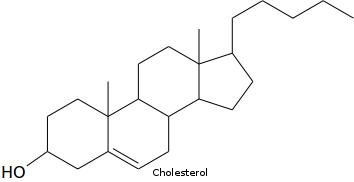
Cholesterol molecule
As you can see, cholesterol is a fairly complex molecule. It’s not important to know exactly what all the lines and angles mean. Suffice to say the lightning bolt line at the top right signifies a fatty acid chain – a lot of carbons and hydrogens hooked together. Other than that, make note of where the double bond is (in the lower part of the cyclic structure second from the left) and the location of the hydroxyl group (that OH — or HO — in the lower left corner). Now look at the structure of a cortisol molecule.
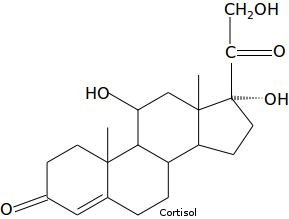
Cortisol molecule
Not a whole lot of difference, is there? That’s because cholesterol is a precursor to cortisol and other steroid hormones like it, testosterone, for instance. Knock a couple of small components off a cholesterol molecule, and substitute some slightly different ones, and you have a key stress hormone. Hmm. Research shows a link between high stress levels and high cholesterol levels. I’m wondering could the high cholesterol levels just be the cholesterol morphing into cortisol to fuel the stress response? And did all the cholesterol come from the stressed person’s diet, or could some of it have been pulled out of the cell membranes (leaving the membranes vulnerable to stressors themselves)?
In a stress response, the body appropriates resources from wherever it needs to, and damn the consequences to the “donor” tissue. Typically a stress response won’t last long. Think of zebras running from a lioness. As soon as they outrun her, or she succeeds in taking down one of their comrades, the other zebras stop and placidly resume grazing. Not so us humans, who often feel like that lioness is chasing us 24/7. Prolonged stress makes us sick. Dealing with stress often cures us.
In treating high cholesterol, doctors are often quick to prescribe statin drugs, and those can be very effective if they don’t cause any unpleasant side effects, but dietary changes and behavior modifications are equally important. In those commercials where the person says “diet and exercise weren’t enough to lower my cholesterol,” I wonder if anyone thought to ask them if they felt stressed a lot of the time. I guess the drug company didn’t think that was important.
Sources: These are general articles on line. For further reading, see the references listed with these articles.
http://www.webmd.com/balance/stress-management/news/20070820/coping-with-stress-helps-cholesterol
 Eukaryotes R Us